If you are considering ProDentim, understanding its ingredients is an important step before making a purchase. The supplement is marketed as an oral probiotic designed to support oral wellness, including healthy teeth and gums and fresher breath. But what is actually in the formula, what do the prodentim ingredients do, and how strong is the scientific evidence behind them?
In this ProDentim ingredients guide, we examine the probiotic organisms, supporting ingredients, supplement facts, potential benefits, and safety considerations. We will also explain why ingredient lists published online may differ and why checking the label on the product you purchase matters.
The key takeaway: ProDentim is built around an oral-probiotic concept, but the presence of an ingredient does not prove that the finished supplement delivers every advertised benefit. Research findings depend on the specific probiotic strain, dose, formulation, and health outcome being studied.
If you want a broader overview of the product, read our detailed ProDentim review before deciding whether it fits your needs.
Table of Contents
What Is ProDentim?
ProDentim is a dietary supplement marketed for oral health. Unlike conventional toothpaste and mouthwash, which form part of a regular oral-hygiene routine, ProDentim is designed to introduce probiotic microorganisms into the mouth.
The idea behind oral probiotics is that selected microorganisms may influence the balance of bacteria living in the oral cavity. This community is often called the oral microbiome.
Not all oral bacteria are harmful. The mouth naturally contains a wide variety of microorganisms, and researchers are investigating whether certain probiotic strains can influence microbial balance, gum health, plaque-related outcomes, and bad breath.
However, there is an important distinction between studying probiotics as a category and proving the effectiveness of a specific commercial supplement. Evidence supporting one strain cannot automatically be applied to every product containing a related species.
That is why examining the ProDentim ingredients list alongside the available scientific evidence is more useful than relying on promotional claims alone.
ProDentim Ingredients List: What Is Actually Inside?
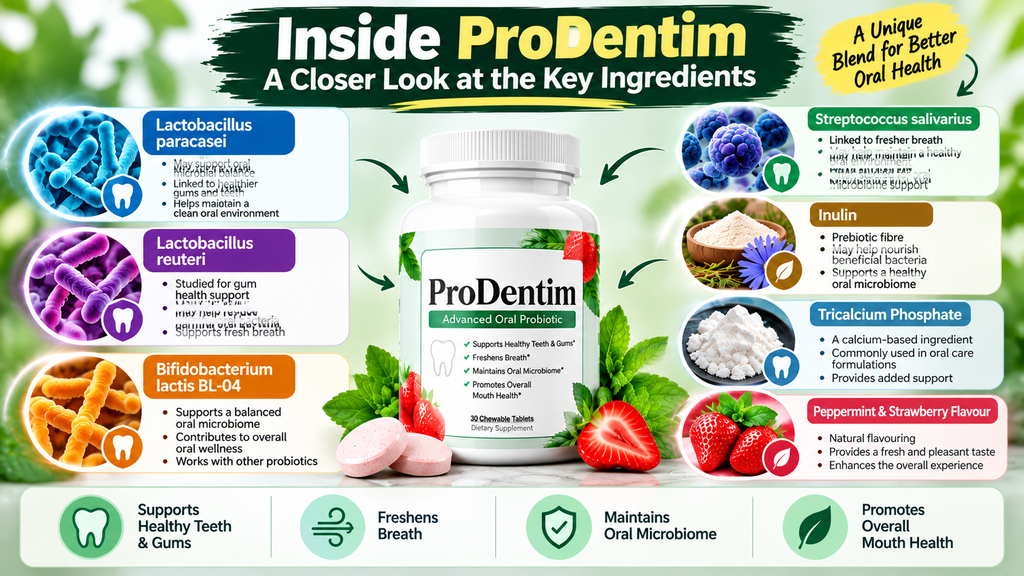
The first thing to understand about the ProDentim ingredients list is that online descriptions may not all reflect the same formulation.
A previously filed ProDentim label in the US National Institutes of Health Dietary Supplement Label Database lists a probiotic blend containing Lactobacillus paracasei, Lactobacillus reuteri, and Bifidobacterium lactis BL-04. Other product-label information and seller descriptions may include additional ingredients, such as inulin, Streptococcus salivarius, peppermint, strawberry flavor, or tricalcium phosphate.
These differences mean that you should not assume every prodentim ingredients mentioned in an online article appears on every version of the product.
For a reliable assessment, check the Supplement Facts panel on the bottle you intend to purchase and compare it with the current seller information.
1. Lactobacillus paracasei
Lactobacillus paracasei is a probiotic bacterial species that has been investigated for its possible role in supporting microbial balance.
Researchers have explored particular strains of this species in relation to oral microorganisms and other health outcomes. However, findings from one strain or research setting cannot automatically establish that another strain will have the same effect.
Potential role: Supporting research into microbial balance and oral wellness.
What the evidence means: The species is relevant to probiotic research, but the presence of Lactobacillus paracasei in ProDentim does not independently prove that the supplement will prevent cavities, treat gum disease, or eliminate bad breath.
The specific strain, amount, and quality of product-level evidence matter when assessing any probiotic.
2. Lactobacillus reuteri
Lactobacillus reuteri is another probiotic species that has received attention in oral-health research.
Certain strains have been investigated as possible additions to conventional periodontal care, including research examining gum inflammation and related clinical measurements.
Some studies suggest that selected probiotic strains may provide additional benefits in particular settings. Nevertheless, results vary, and probiotics should not replace professional treatment for existing gum problems.
Potential role: Research into oral microbial balance and selected gum-health outcomes.
Important limitation: The evidence for a particular Lactobacillus reuteri strain does not prove that every product containing this species will deliver the same outcome. The strain identity and formulation used in the research must be considered.
If you are evaluating ProDentim ingredients, this distinction is essential because species names alone do not tell you everything about a probiotic’s expected performance.
3. Bifidobacterium lactis BL-04
Bifidobacterium lactis BL-04 is a probiotic strain identified in previously filed ProDentim label information.
Probiotics from the Bifidobacterium group have been studied for different aspects of human health. However, research on immune or digestive outcomes should not automatically be interpreted as proof of a dental benefit.
Potential role: Contributing to the probiotic component of the formulation.
What buyers should know: The presence of BL-04 does not establish that ProDentim will improve gum health or prevent dental disease. Those outcomes require appropriate evidence for the relevant strain, dose, and finished product.
When reviewing probiotic supplements, it is better to examine the precise claims being made than to assume all probiotic organisms work in the same way.
4. Streptococcus salivarius
Some ProDentim product descriptions and label information identify Streptococcus salivarius as an ingredient.
Certain strains of this species have been studied for possible applications involving oral microorganisms and breath-related outcomes. However, strain identification is especially important when interpreting such research.
A product label that names only the species does not necessarily establish that the ingredient is one of the specific strains used in a clinical study.
Potential role: A possible contributor to the product’s oral-probiotic formulation.
Important limitation: Do not assume that results associated with a particular researched strain apply to ProDentim unless the strain identity and relevant evidence can be verified.
5. Inulin
Inulin is a type of prebiotic fibre commonly obtained from plant sources, including chicory root.
Unlike probiotics, which are live microorganisms, prebiotics are substances that can serve as a food source for selected microorganisms. Inulin is therefore different from the probiotic bacteria included in a supplement.
Some product descriptions identify inulin as part of the ProDentim formula, but its presence and quantity should be confirmed against the current Supplement Facts panel.
Potential role: Acting as a prebiotic ingredient in formulations that contain it.
What to keep in mind: The presence of inulin does not prove that a supplement will produce a particular oral-health outcome. Its effect depends on the formulation and the evidence available for the intended use.
6. Tricalcium Phosphate
Tricalcium phosphate is a calcium-and-phosphate compound used in a range of food, supplement, and oral-care formulations.
Depending on the product formulation, it may serve a supporting or formulation-related purpose. Its presence on an ingredient list should not automatically be interpreted as evidence that the supplement repairs teeth or rebuilds enamel.
Potential role: A supporting ingredient in certain formulations.
Important limitation: The amount, purpose, and classification of tricalcium phosphate should be checked on the actual product label. Do not confuse an ingredient’s chemical properties with proven benefits from the finished supplement.
7. Peppermint and Strawberry Flavouring
Some ProDentim labels and seller descriptions identify peppermint and strawberry flavouring or related flavour ingredients.
These ingredients may contribute to the product’s taste and overall user experience.
Potential role: Flavouring and formulation support.
What buyers should know: A pleasant taste or minty sensation is not proof that a product has reduced harmful bacteria, prevented tooth decay, or treated a dental condition.
If you have a known sensitivity or allergy, review the complete ingredient list before use.
ProDentim Ingredients Facts: What Do the Numbers Mean?
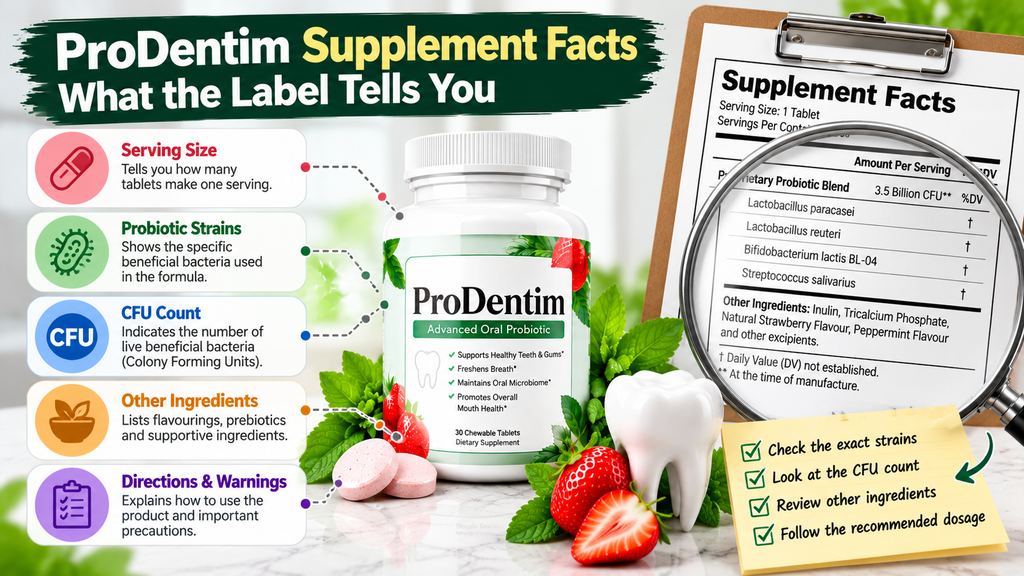
Understanding ProDentim ingredients facts means looking beyond the ingredient names.
A supplement label can provide information about the serving size, quantity of ingredients, probiotic count, other ingredients, directions, and precautions.
However, not every label discloses the same level of detail. Older label information in the NIH Dietary Supplement Label Database lists a proprietary probiotic blend and names its constituent organisms. Other product information may describe a different formulation.
Here are the most important details to check.
| Label detail | Why it matters |
|---|---|
| Serving size | Shows the amount the label defines as one serving |
| Probiotic species and strains | Helps determine whether research on a specific organism is relevant |
| CFU count | Describes colony-forming units, a measure associated with viable microorganisms |
| Amount per ingredient | Helps show how much of each listed ingredient is included |
| Other ingredients | Identifies flavourings, excipients, and other formulation components |
| Directions and warnings | Explains how the product is intended to be used and what precautions apply |
What Does CFU Mean?
CFU stands for colony-forming units. It is a measure used to estimate viable microorganisms capable of forming colonies under specified testing conditions.
Some ProDentim descriptions advertise a total of 3.5 billion CFU. If that number appears on the current label, check exactly what it represents and whether the label specifies when the count applies.
A combined CFU figure does not necessarily tell you how much of the total comes from each individual probiotic strain. Without a disclosed breakdown, you cannot accurately calculate the contribution of each organism.
Also, a CFU count alone does not establish clinical effectiveness. The identity of the microorganisms, the amount used, product quality, storage conditions, and the relevant clinical evidence all matter.
Why Do ProDentim Ingredients Lists Differ Online?
Different websites may display different ingredients because they rely on older labels, promotional descriptions, or information from different product versions.
For example, a previously filed label may not include every ingredient mentioned in newer marketing material. This does not, by itself, prove that a particular website is correct or that the formula has definitely changed.
The most responsible approach is to verify the physical product label and current seller information before publishing or relying on an ingredient list.
For reference, you can review the ProDentim entry in the NIH Dietary Supplement Label Database. Remember that the entry describes a historical label, not necessarily the current formulation.
ProDentim Ingredients Benefits: What Can They Realistically Do?
When evaluating ProDentim ingredients benefits, it is important to separate a plausible scientific mechanism from a proven result.
Here are three areas worth understanding.
Supporting Oral Microbial Balance
The oral microbiome contains many microorganisms that coexist in a complex environment.
Researchers are studying whether selected probiotic strains can influence this environment. However, a change in microbial composition is not automatically equivalent to an improvement in dental health.
Any claim about ProDentim’s effectiveness should be supported by evidence relevant to the actual product and the specific outcome being discussed.
Potential Support for Gum Health
Research on certain probiotic strains has explored whether they can provide additional benefits alongside conventional periodontal treatment.
The findings are not uniform across all strains or studies. ProDentim should not be described as a proven treatment for gingivitis or periodontitis unless appropriate product-specific evidence supports that claim.
Bleeding, swollen, or painful gums should be assessed by a dental professional.
Fresh Breath and Oral Comfort
Bad breath can be associated with tongue coating, food debris, dry mouth, gum disease, and other oral or medical conditions.
Certain probiotics have been investigated for their potential effects on breath-related outcomes. Nevertheless, it is not appropriate to promise that ProDentim will eliminate persistent bad breath.
Good oral hygiene and identifying the underlying cause remain important.
Are ProDentim Ingredients Scientifically Proven?
This is one of the most important questions to ask before purchasing the supplement.
Research on oral probiotics suggests that certain strains may have potential for selected oral-health outcomes. However, results depend on the organism studied, the dose, the treatment duration, and the outcome measured.
Evidence for an individual ingredient is not the same as evidence for the finished ProDentim product.
To assess a product-specific claim, look for well-designed human clinical trials that test the actual formulation at a relevant dose. Ideally, these studies should report meaningful clinical outcomes and clearly describe their methods and limitations.
Be cautious if a website uses a study about a different probiotic strain, a different delivery method, or an unrelated health outcome to support a broad claim about ProDentim.
The same principle applies to phrases such as “clinically researched ingredients.” Research on an ingredient does not necessarily mean the finished product has been clinically demonstrated to provide the advertised benefit.
Understanding the ingredients is only one part of the decision; you can also explore whether ProDentim really works and what the available evidence suggests.
Is ProDentim Safe? Ingredients and Precautions
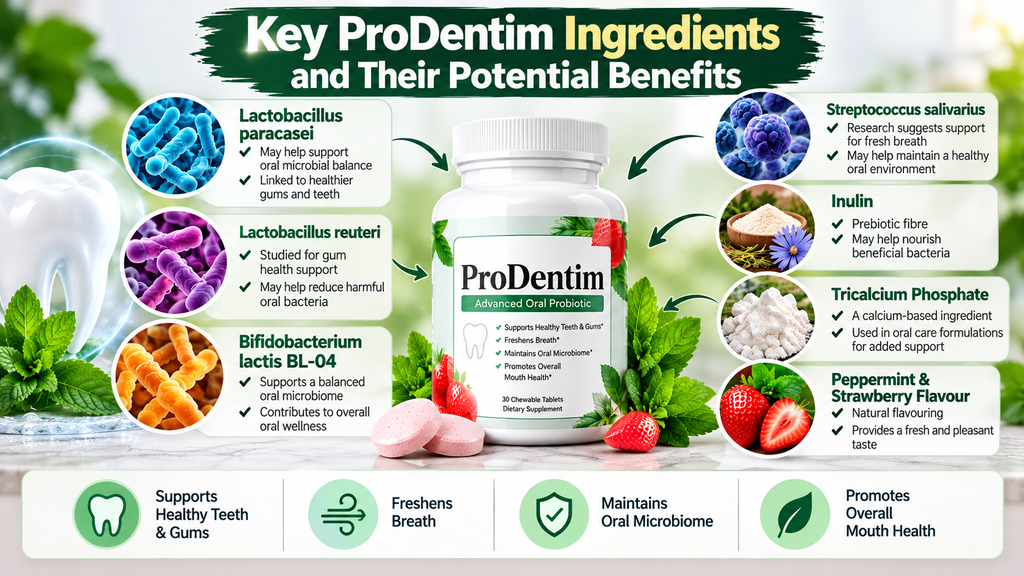
Safety depends on the formulation, the user’s health, possible allergies, and other individual factors.
Before using ProDentim, read the current product label and follow its directions. Do not assume a supplement is risk-free simply because it contains probiotics or ingredients described as natural.
Consider these precautions:
- Check all listed ingredients if you have food allergies or known sensitivities.
- Ask a healthcare professional before using the supplement if you are pregnant, breastfeeding, taking medication, or managing an underlying medical condition.
- If you have significant immune-system problems, seek medical advice before taking products containing live microorganisms.
- Stop using the product and seek appropriate medical advice if you experience a concerning reaction.
- Store the supplement according to the instructions on its packaging.
If you experience persistent bad breath, bleeding gums, tooth pain, swelling, or other dental symptoms, consult a dentist rather than relying on a supplement.
For general information on maintaining oral health, see the American Dental Association’s home oral-care guidance.
How to Check the ProDentim Ingredients Label Before Buying
If you want to know what is in ProDentim, the most reliable starting point is the label for the exact product you plan to purchase.
Use this checklist before ordering:
- Check the Supplement Facts panel. Read the serving size, ingredient names, quantities, and any stated CFU information.
- Compare the seller’s ingredient list. Look for differences between promotional descriptions and the label.
- Check strain identification. Confirm whether the label provides specific strain designations or only species names.
- Review other ingredients. Check flavourings, excipients, and potential allergens.
- Read directions and warnings. Follow the actual label rather than instructions copied from unrelated websites.
- Verify the seller and package. Check product details, expiry information, and applicable purchase terms.
If the information is unclear, contact the seller or ask a qualified healthcare professional for guidance.
Final Verdict: What Is Actually in ProDentim?
ProDentim is marketed as an oral-probiotic supplement, and its published ingredient information includes probiotic organisms such as Lactobacillus paracasei, Lactobacillus reuteri, and Bifidobacterium lactis BL-04. Depending on the product information or formulation being referenced, other ingredients may also be listed.
The most important point is that the current product label should guide your understanding of what is actually in the bottle. Ingredient lists can differ across online sources, and older label records should not automatically be treated as definitive evidence of the current formula.
The probiotic ingredients are relevant to ongoing oral-health research, but their presence does not prove that ProDentim prevents cavities, treats gum disease, or guarantees fresher breath. Those conclusions require evidence that matches the specific formulation and health outcome.
If you are considering ProDentim, compare the current label, available scientific evidence, safety information, and price before making a decision. Most importantly, continue established oral-care practices and consult a dentist about persistent symptoms.
Frequently Asked Questions
1. What is in ProDentim?
Published ProDentim ingredient information identifies probiotic organisms including Lactobacillus paracasei, Lactobacillus reuteri, and Bifidobacterium lactis BL-04. Other ingredients may be listed depending on the formulation. Always check the current product label.
2. What are the main ProDentim ingredients?
The main prodentim ingredients described in published product information include probiotic organisms. Some labels or product descriptions also identify ingredients such as inulin, Streptococcus salivarius, peppermint, flavourings, and tricalcium phosphate.
3. What do ProDentim ingredients benefits mean?
The prodentim ingredients are associated with research into probiotics and oral wellness. However, the benefits of individual strains cannot automatically be attributed to the finished supplement, and results are not guaranteed.
4. Does ProDentim contain 3.5 billion CFU?
Some ProDentim product information describes a total of 3.5 billion CFU. Check the label on the product you intend to buy to confirm the current figure and what it represents.
5. Are ProDentim ingredients clinically proven?
Some probiotic strains have been studied in clinical research, but that does not establish that every ProDentim ingredients or the finished supplement has been proven to deliver the advertised benefits.
6. Where can I find ProDentim supplement facts?
Check the Supplement Facts panel on the product packaging and the seller’s current product page. The NIH Dietary Supplement Label Database also contains historical label information, which may differ from the current formulation.